
Sunscreen is the most-searched, least-measured product in skincare. The questions people actually type are not “which brand?” — they are “do I need it every day?”, “what is the two finger rule?”, “is a quarter teaspoon enough?”, “can I use last year’s?” This is The Radiant Routine, Guide #31 — the first of our Spring Edit — and it is the dosage manual the internet keeps asking for: what SPF and PA actually mean, exactly how much to apply (with the rule that finally makes it measurable), when the viral “rules” are folklore, and the honest answers to the skeptic’s questions, including the vitamin D one.
Quick note: this guide recommends one tinted sunscreen already featured in our library; its link further down is an affiliate link, and the full disclosure sits at the end, where it always does on this site.
Quick Answer
Yes — on any day your skin sees daylight, sunscreen earns its place, because the rays that age skin (UVA) arrive through clouds, winter and window glass, not just on beach days. Choose broad-spectrum SPF 30 or higher. Apply the two-finger rule for face and neck (a line of product along your index and middle fingers, roughly ½ teaspoon) and about one ounce — a shot glass — for the body. Put it on 15 minutes before going out, and reapply every 2 hours outdoors and after swimming or sweating. The single biggest fact in this guide: most people apply only a quarter to a half of the tested amount, and under-applying collapses the protection — a carefully chosen SPF 50 worn thin can perform like an SPF 5. Dose is destiny.
Do You Really Need It Every Day?
Split the question the way dermatologists do. Sunburn rays (UVB) swing with season, weather and hour — a grey January morning carries little burn risk. Aging rays (UVA) are the steady ones: present all year, through cloud cover, and through ordinary window glass — which is why “even indoors?” and “even in winter?” get a qualified yes. If you sit beside a bright window all day or drive a lot, your exposed skin is quietly logging UVA hours. If your day is genuinely windowless and dark-commuted, the marginal benefit of a morning application is small, and this site will not pretend otherwise. The practical rule most dermatologists actually live by: SPF as the last step of the morning routine, every day, without negotiating with the weather app — because habits beat daily judgment calls, and the days you skip are never the days you predicted.
SPF, Decoded
SPF measures protection against UVB — the burn rays — and the numbers are closer together than the marketing suggests. At the full tested dose, SPF 15 filters about 93% of UVB, SPF 30 about 97%, and SPF 50 about 98%. Nothing reaches 100%, and doubling the number does not double the protection — which is why the American Academy of Dermatology sets the sensible floor at SPF 30, not SPF 100. Two corollaries matter more than the number on the front: a higher SPF is not permission to apply less or reapply later (the 2-hour clock is the same), and SPF says nothing about UVA — for that you need the next section’s label.
PA and “Broad Spectrum”: the UVA Half
UVA is the aging half of the spectrum: wrinkles, dark spots, and the slow damage that shows up a decade later. Asian sunscreens grade it with the PA system — PA+ up to PA++++ — based on how well the formula prevents UVA tanning. US sunscreens are not allowed to print PA grades; the American equivalent claim is “broad spectrum”, which certifies the product protects against UVA as well as UVB. So the label check is simple on both systems: SPF 30+ and PA+++ or higher, or SPF 30+ and “broad spectrum”. One upgrade deserves a special note for anyone prone to dark marks or melasma: tinted sunscreens add iron oxides, which also block part of the visible light that can deepen pigmentation — a genuine functional reason to choose a tinted formula, beyond hiding white cast.
The Two-Finger Rule (and the Full Dose Table)
SPF ratings are tested at 2 milligrams of product per square centimeter of skin — a thicker layer than anyone applies by instinct. Studies consistently find real-world application at 25–50% of that dose, and the protection falls off a cliff: half the dose of an SPF 30 can perform around SPF 5. The two-finger rule exists to close that gap without a kitchen scale: squeeze a line of sunscreen along the full length of your index and middle fingers, base to tip — that is your face-and-neck dose (about ½ teaspoon). The rest of the AAD’s arithmetic:
- Face and neck: two finger-lengths (≈ ½ teaspoon). The “quarter teaspoon” figure floating around covers a small face alone, with nothing for the neck — the most-forgotten real estate in sun protection.
- Full body (swimsuit coverage): about 1 ounce — a shot glass, roughly 6 teaspoons.
- Each arm: ≈ ½ teaspoon. Each leg: ≈ 1 teaspoon. Front and back torso: ≈ 1 teaspoon each.
- The forgotten zones: ears, back of the neck, tops of the feet, and lips (use an SPF lip balm) — the spots dermatologists meet later, professionally.
The Viral Rules, Audited
The tree for this guide is full of numbered rules — the “20 second rule”, the “123 rule”, “three rules for sunscreen”. Audit result: none of them is an official guideline; they are social-media mnemonics wearing a lab coat, and their numbers do not survive a source check. What survives is duller and better — the actual trio every dermatology body repeats: (1) enough (two fingers / one ounce), (2) before (about 15 minutes ahead, so the film sets), (3) again (every 2 hours outdoors). If a rule you saw online helps you remember those three, keep it as a memory aid — just do not let a catchy count replace the dose.
Order, Layering and the Makeup Question
Sunscreen is the last step of skincare and the first step of makeup: cleanser, treatments, moisturizer, then sunscreen, then makeup. Give moisturizer a few minutes to settle so the sunscreen film forms evenly on top rather than mixing into a thinner soup. Chemical (organic) filters in particular want those ~15 minutes on skin before sun exposure; mineral filters sit on the surface and work as soon as they are evenly spread — one more reason not to rub endlessly: spread it, smooth it, and let it be. “Rubbing in” until it vanishes usually means you have spread a face dose over a face-and-a-half. And the standing answer to the makeup question from our cushion foundation guide: the SPF printed on makeup does not count as your sunscreen — nobody applies foundation at two-finger thickness, and the dose is the protection. Reapplication over makeup is the one genuinely unsolved problem in this field; SPF sprays and powders exist for it and are better than nothing, but the honest hierarchy is: reapply lotion if you can, use the spray/powder if you can’t, and wear the hat either way.
Reapply: the Step Everyone Skips
Sunscreen leaves your skin on schedule — absorbed, sweated, swum and toweled off — which is why the instruction is every 2 hours outdoors, and immediately after swimming, heavy sweating or toweling, regardless of the SPF number. “Water resistant” on a US label is a regulated, modest claim: the formula keeps its protection for 40 or 80 minutes in water (the label must say which); “waterproof” is a claim no sunscreen is allowed to make, because none is. Is one morning application enough? For a day spent indoors away from windows, mostly yes — the incidental exposure is small. For any day with real outdoor time, once is a morning-only policy, and your skin keeps the receipts.
Chemical vs. Mineral: Which Type Is Better?
Mineral (physical) sunscreens — zinc oxide and titanium dioxide — sit on the skin and reflect/scatter UV; they work immediately, rarely sting eyes, and are the default recommendation for children, pregnancy and reactive skin. Chemical (organic) filters absorb into the top layer and neutralize UV; they tend to feel lighter, spread thinner and disappear on more skin tones — the texture advantage is why many people actually wear them daily. Downsides exist on both sides and this site lists them plainly: minerals can leave a white cast (tinted versions are the standard fix) and can feel drier; chemical filters can irritate sensitive skin, and some are restricted in a few reef-protection jurisdictions (Hawaii’s rules cover specific filters like oxybenzone — check local rules when traveling). The dermatologist answer to “which is better” is boring because it is true: the one you will apply at full dose, every day. A perfect mineral worn twice a week loses to a good chemical worn daily, and vice versa.
The Skeptic’s Corner
The tree asks it directly: “why do dermatologists push sunscreen so much?” Because of their appointment books: roughly 1 in 5 Americans develops skin cancer in their lifetime, and about 9,500 are diagnosed every day — most of it UV-driven, most of it arriving on skin that simply accumulated unprotected years. Sunscreen is the rare intervention that addresses both that and the cosmetic ledger (UV is the dominant driver of visible facial aging). Now the honest downsides, since the tree asks for those too: daily sunscreen costs money and minutes; some formulas sting, pill under makeup or break people out; and no long-term study can follow a human for the 40 years the perfect trial would need — the recommendation rests on strong but partly indirect evidence, which is exactly how we described it in our skin transition guide. And vitamin D — “does sunscreen block it?” In laboratory conditions a perfect film can reduce the skin’s vitamin D production; in real life, typical use has not been shown to cause deficiency in the general population, and dermatology’s answer is consistent: if you are worried about vitamin D, fix it at the table or with a supplement (that is literally Guide #21) — do not fix it with unprotected UV. Finally, “what if I don’t want to use it daily?” is a legitimate question with a legitimate answer: shade, clothing and timing are real protection. A UPF 50 garment blocks about 98% of UV and never needs reapplying; a wide-brim hat shades the zones sunscreen users forget. Sunscreen is layer one of a system, not a moral obligation.
Which Sunscreens Should You Stay Away From?
The tree asks this three times, so here is the honest avoid-list. Expired sunscreen — the date passed, the dose is unmeasured. “Tanning oils” with token SPF — an SPF 4–8 oil is a tanning product wearing a sunscreen costume. Anything claiming “sunblock”, “waterproof” or “all-day protection” — regulators do not allow those claims because no product does those things; a label that lies about the category will lie about the rest. DIY/homemade sunscreen from a recipe blog — its SPF is untested and unknowable, and dose is destiny. Sprays applied in the wind and never rubbed in — half the film lands on the breeze; spray close, spread with your hands. And treat SPF under 15, or anything not broad spectrum, as sunburn-only help: US labels on those products must literally carry a notice that they have not been shown to protect against skin cancer or early skin aging.
Does Skin Tone Change the Answer?
“What race gets sunburned the least?” appears in three of the four branches — here is the factual version. Melanin is real, partial protection: deeply pigmented skin burns less readily, and its built-in protection is often estimated in the range of a low SPF. But “less readily” is not “never”: skin cancer occurs in every skin tone, UVA ages every skin tone, and pigmentation concerns like melasma are often more common in deeper tones. The harder problem is timing — in darker skin, skin cancers are on average diagnosed later, when they are more dangerous. The AAD’s recommendation does not come with a skin-tone exemption, and neither does this guide’s: dose and reapply like everyone else, and let tinted formulas solve the white-cast problem that historically made the advice unusable.
What Did Humans Do Before Sunscreen?
Mostly what this guide keeps recommending alongside the bottle: shade, clothing, hats, timing the day around the sun — plus pastes. Ancient Egyptians used rice bran and jasmine extracts; Greeks used olive oil; several cultures used ochre and mineral pastes that were, functionally, primitive mineral sunscreen. And the rest of the honest answer: they burned, outdoor workers aged visibly fast, skin cancers are described in medical writing going back centuries, and shorter average lifespans hid part of the ledger — many people simply did not live long enough to collect the 60-year bill. Commercial sunscreen is a 1930s–40s invention; the behaviors around it are ancient. You are not choosing between “natural” and “modern” — you are choosing which of the old tools to combine with the new one.
Kids, Pregnancy and Last Year’s Tube
- Children: for babies under 6 months, shade and clothing come first, with sunscreen only on small exposed areas when shade is impossible. For kids generally: SPF 30+ broad spectrum, mineral formulas are the gentle default, and reapply like it is your job — at the beach, it is.
- Pregnancy: dermatologists generally steer pregnant readers to mineral sunscreens (zinc oxide/titanium dioxide sit on the skin rather than absorbing), and a tinted mineral doubles as melasma defense. When in doubt, your obstetrician outranks any article, including this one.
- Last year’s sunscreen: yes, if it is within its printed expiration date and was stored at normal temperatures — check the date, and retire any tube whose texture has separated, turned grainy or smells off. Sunscreens are formulated to hold their SPF for about three years unopened under decent conditions; a tube that spent the summer cooking in a car is a donation to the trash, not a bargain.
The One We Keep Recommending
Our library’s standing daily-face pick applies this whole guide in one product: a tinted, broad-spectrum SPF 50 — the tint does the iron-oxide work described above, the texture survives makeup, and it is the same bottle from our BB cream comparison and winter routine guides.
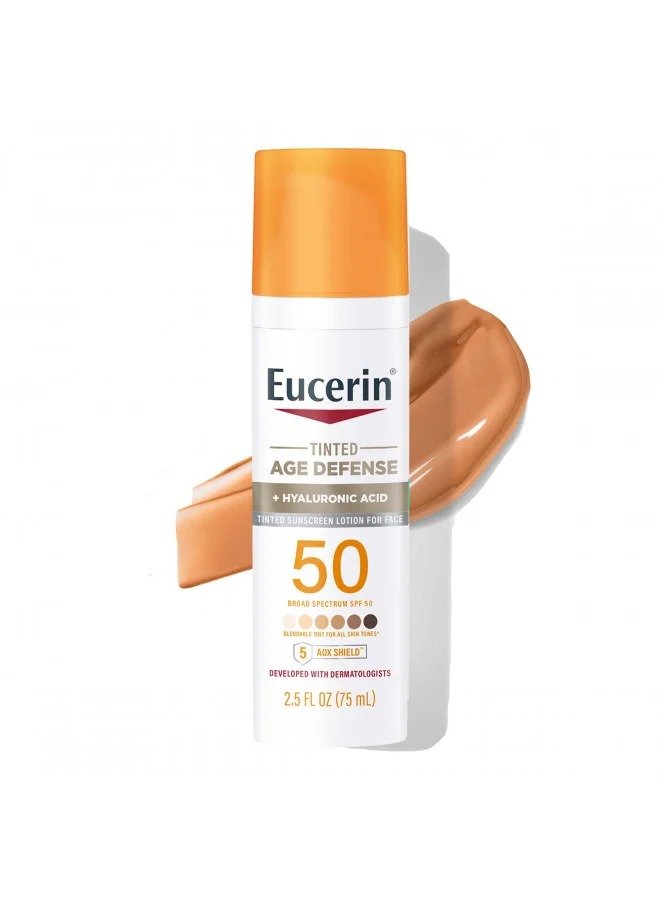
Eucerin Sun Tinted Age Defense SPF 50
A tinted face sunscreen with broad-spectrum SPF 50 and hyaluronic acid. The blendable tint replaces the white-cast problem with light coverage, and the iron oxides in the tint add the visible-light defense that matters for dark spots. Two finger-lengths, last step before makeup.
Frequently Asked Questions
Do I need sunscreen in winter or on cloudy days?
UVB drops, UVA does not — it comes through clouds and glass all year. For daylight-facing days, yes; for a genuinely dark, indoor day, the benefit is small and skipping is not a scandal.
Is applying sunscreen once a day enough?
Only for indoor days. Outdoors, the film is gone on schedule — reapply every 2 hours and after swimming, sweating or toweling, whatever the SPF.
How long after applying am I protected?
Give it about 15 minutes before exposure so the film sets — that is the real instruction hiding behind the viral “rules”. Mineral formulas protect as soon as they are spread evenly.
Does the SPF in my moisturizer or makeup count?
Only if you apply it at sunscreen dose — two finger-lengths of foundation is a look nobody wears. Treat makeup SPF as a bonus, never the plan.
When should I NOT wear sunscreen?
At night, obviously — and patch-test new formulas if your skin is reactive. Beyond that, there is no outdoor scenario where dermatology recommends bare skin over protection; choose shade and clothing if you prefer them.
Does sunscreen expire?
Yes — respect the printed date, store tubes away from heat, and discard anything separated or grainy. An expired sunscreen is an unmeasured sunscreen. A 10-year-old tube is not a gray area; it is a no.
Is SPF 50 too high for daily face use?
No. The real-world difference between SPF 30 and 50 is small at full dose — but since almost everyone under-applies, the higher number works as a partial buffer for imperfect dosing. There is no “too high” problem at SPF 50; there is a too-thin problem at every number.
Does drinking water help a sunburn?
It helps you — sunburned skin draws fluid and dehydration is common — but water does not repair UV damage. Cool compresses, a gentle moisturizer and time do the work; blistering, swelling or chills are a doctor visit, not a hydration strategy.
What vitamin prevents sun damage?
None, honestly. Antioxidants like vitamins C and E are studied as supporting players (mostly in topical formulas, alongside sunscreen) — none is a shield you can swallow instead. The vitamin relationship with the sun runs the other direction: see the vitamin D answer in the Skeptic’s Corner above.
The Bottom Line
Sunscreen fails in the measuring, not in the molecule. Pick broad-spectrum SPF 30+ in a texture — and a tint, if pigmentation is your concern — that you genuinely like; dose it with the two-finger rule instead of a hopeful smear; put it on 15 minutes before the day starts; and reapply on the 2-hour clock when you are actually out in it. Do that and the most argued-about product in beauty becomes the simplest: a morning habit with a forty-year payoff. Spring is the right season to start it — the light is already changing, even if the temperature hasn’t admitted it yet.
Sources & Further Reading
- UCLA Health — “How to Apply Sunscreen Correctly” (the AAD’s one-ounce body dose, two-finger face dose, SPF 30+ broad-spectrum standard, 15-minutes-before and 2-hour reapplication rules, and the 1-in-5 skin cancer figure): uclahealth.org
- GetSunUp — “How to Apply Sunscreen Properly: A Dermatologist-Backed Guide” (the 2 mg/cm² testing standard, why applying half can drop SPF 30 toward SPF 5, and the per-zone dose table): getsunup.app
- UVMeLife — “SPF 101: How Much Sunscreen You Actually Need” (SPF 30 filtering ~97% of UVB, the nickel/two-finger equivalence, and why high SPF is not an excuse to skip reapplication): uvmelife.com
- BeautyStone / Hongdae Seoul Clinic — “Sunscreen: How to Read SPF & PA Numbers” (the PA grading system for UVA, daily versus outdoor SPF/PA guidance, and water-resistance durations of 40/80 minutes): beautystone1.com
Affiliate disclosure: Glow & Vital is reader-supported. When you buy through a link on this page — the Eucerin sunscreen above — we may earn a commission from Amazon at no additional cost to you. It never changes what we recommend: the product in this guide was already in our library from Guides #7 and #17, and the dosing advice above applies to whatever sunscreen you already own. This article is educational and is not medical advice; for personal sun-protection guidance — especially during pregnancy or for children — ask your own clinician.
One Response