
Every winter, the same quiet experiment runs across the northern half of the United States: the sun keeps shining, people keep going outside — and their vitamin D levels fall anyway. The research behind this guide asked the season’s real questions: how much vitamin D should I take in winter, is D3 better than plain vitamin D, how much time outside is enough, and should I take it all year round? This is Guide #21 of The Radiant Routine, opening Wave 5 with the one supplement winter genuinely changes. The honest version is more interesting than the marketing version: your skin has a production season, most northern cities are outside it for months, a blood test settles every argument symptoms can’t, and the right dose is smaller — and more specific — than the megadose bottles suggest.
Quick note: the product below carries an affiliate link — our full disclosure is at the end of this article. This guide is educational and is not medical advice; vitamin D decisions that involve a diagnosed deficiency or a daily medication belong with your clinician.
The Quick Answer
Above roughly 37° north latitude — a line that runs through San Francisco, Denver, St. Louis and Richmond — winter sunlight contains too little UVB for skin to make meaningful vitamin D, no matter how much time you spend outdoors. In the classic experiment, winter sun in Boston (42°N) produced no vitamin D in skin from November through February. So winter vitamin D comes from food and, for many northerners, a supplement. The reference amounts (NIH): 600 IU a day for adults up to 70, 800 IU after 70, and a hard ceiling of 4,000 IU a day from all sources unless a clinician is treating a measured deficiency. D3 is the form that raises blood levels best. And the only way to know whether you need any of this is a 25(OH)D blood test — symptoms won’t tell you.
The Vitamin D Winter Is a Physics Problem
Your skin makes vitamin D when UVB light converts a cholesterol precursor (7-dehydrocholesterol) into previtamin D3. UVB is fragile: when the sun sits low, its rays travel through more atmosphere, and the UVB is largely filtered out before it reaches you. In 1988, researchers exposed human skin samples to real winter sunlight and measured the result: in Boston, from November through February, production was zero; in Edmonton (52°N), the dead season ran October through March; further south, at 34°N, winter sun still worked. A useful field rule: if your shadow is longer than you are tall, the sun is too low to make much vitamin D — which in a northern winter is most of the day. This is why “just get more sun” fails as winter advice in Chicago or Boston, however well it works in Miami. It is also why nobody should feel guilty about it: you cannot out-walk geometry.
Who Actually Runs Low
U.S. survey data (NHANES 2011–2014, via the NIH) puts about 5% of Americans below 12 ng/mL — the deficiency-risk zone — and another 18% between 12 and 20 ng/mL, potentially inadequate for some people. The risk concentrates in predictable places:
- Northern winters, for the physics above: months of zero production drain the stores built in summer.
- Darker skin. Melanin is natural sun protection, and it lengthens the sun exposure needed to make the same amount of vitamin D — a real disadvantage at northern latitudes in winter.
- Older skin. Aging skin holds less of the precursor chemical; in a classic study, skin from people in their late seventies and eighties produced less than half the previtamin D of young skin under identical light.
- Indoor lives and covered skin — office work, night shifts, and clothing coverage all cut production in every season.
- Absorption problems. Celiac disease, Crohn’s, ulcerative colitis and gastric bypass can all reduce how much vitamin D you absorb from food and supplements (the “what drains vitamin D” question is usually this, plus a short list of medicines below).
- Higher body weight. Vitamin D is fat-soluble and gets sequestered in body fat, so larger bodies often run lower blood levels on the same intake.
The Test Settles It (Symptoms Don’t)
Search this topic and you will meet lists of “14 signs of vitamin D deficiency.” Read them honestly: fatigue, aches, low mood, hair shedding, slow healing — every one of those has a dozen common causes, and low vitamin D is only sometimes among them. That is why this guide won’t diagnose you from a checklist. The measure that matters is a blood test for 25-hydroxyvitamin D, written 25(OH)D, and the National Academies’ reference ranges (via the NIH) are:
- Below 12 ng/mL (30 nmol/L) — associated with deficiency; this is treatment territory, with a clinician.
- 12 to under 20 ng/mL — inadequate for some people; worth a conversation and usually a modest supplement.
- 20 ng/mL (50 nmol/L) or higher — adequate for bone health in nearly everyone.
- Above 50 ng/mL — where potential harm begins to enter the picture, almost always from supplements, not sun.
Mail-in home test kits (a finger-stick card sent to a lab) exist and are better than guessing; a standard lab draw ordered by your clinician is the reference method and the one to use before any high-dose plan. Test first, dose second — that order is the whole game.
How Much: The RDA, the Ceiling, and the 5,000 IU Problem
The NIH recommended dietary allowance is 600 IU (15 mcg) a day for ages 1–70 and 800 IU (20 mcg) from 71, from all sources combined. The tolerable upper intake level — the ceiling for unsupervised daily use — is 4,000 IU (100 mcg) a day. Two honest consequences follow. First, a daily 1,000 or 2,000 IU supplement sits comfortably inside the system: it covers the RDA several times over for someone whose winter sun contributes nothing, and stays well below the ceiling. Second, the best-selling bottles in this category are 5,000 IU — above the ceiling for everyday use. Doses like that exist for clinician-supervised correction of a measured deficiency, taken for a set period. As a casual daily habit chosen off a shelf, a 5,000 IU softgel is a dose in search of a diagnosis.
Why the ceiling matters more for vitamin D than for most vitamins: you do not pee out the extra. Vitamin D is fat-soluble; surplus is stored in fat and liver, which is precisely what makes winter stores possible — and what makes chronic overdosing cumulative. Toxicity is almost never about one big day; it is months of excess quietly raising blood calcium (hypercalcemia), whose signs are the unglamorous list: nausea, vomiting, poor appetite, weakness, frequent urination, and, if it continues, kidney problems. The fix is not fear — it is arithmetic. Count your total (multivitamin + D supplement + fortified foods), stay under 4,000 IU unless a clinician who has seen your blood test says otherwise, and treat “more” as a medical decision, not a wellness upgrade.
D2 vs. D3: The Short, Settled Answer
“Vitamin D” on a label is one of two molecules. D2 (ergocalciferol) comes from plants and fungi. D3 (cholecalciferol) is the form your own skin makes, sourced in supplements from lanolin or, in vegan versions, from lichen. Both are absorbed; the NIH’s summary of the evidence is that D3 raises blood 25(OH)D more effectively and keeps it higher longer than D2. So when the question is “vitamin D or D3?”, the answer is: D3, at a sane dose, is the default choice — and the form matters less than the dose and the test. Take it with a meal that contains some fat, because a fat-soluble vitamin absorbs better with fat than on an empty stomach; the best time of day is whichever meal makes it a habit.
Food: Real Sources, Honest Expectations
Fatty fish are the standout food source — salmon, mackerel, sardines and trout carry meaningful vitamin D per serving — followed by fortified milk and plant milks, fortified cereals and orange juice, egg yolks (a small amount), and mushrooms exposed to UV light (the only plant source with real quantities). An honest winter menu — fish twice a week, fortified dairy daily — covers a good share of the RDA for many people, and it is the first place to look before a bottle. It is also, for most northerners in February, not quite enough on its own, which is the entire reason this guide has a product section: the supplement’s job is to close a measured gap, not to replace food or pretend the sun still works.
The One Bottle in This Guide
There is exactly one product here, chosen by the same arithmetic as the sections above: D3, at a daily dose that respects the ceiling, from a line whose potency is verified by an independent body rather than asserted by the label.
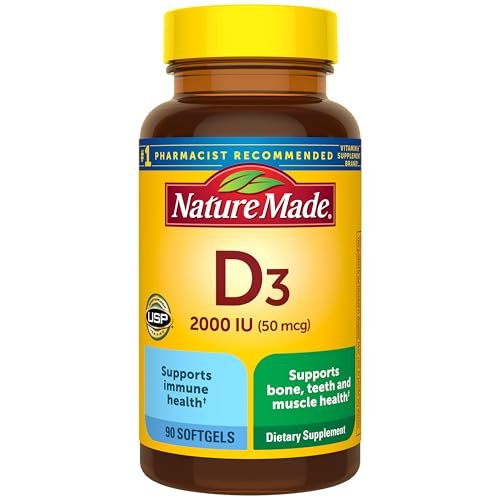
Nature Made Vitamin D3 2000 IU (50 mcg), 90 Softgels — the winter pick, and the reasoning is the guide in miniature. The dose is 2,000 IU: enough to cover the RDA more than three times over for a northern adult whose skin is making none, and half the NIH ceiling, leaving room for a multivitamin and fortified food without a spreadsheet. The form is D3, the one that raises and holds blood levels best. And the bottle carries the USP Verified mark — the United States Pharmacopeia has independently tested that what the label claims is what the softgel contains, at the stated potency. In a category where mislabeled potency is a documented problem (and where the fashionable alternative is a 5,000 IU D3+K2 combo dosed above the ceiling), verified and moderate beats potent and hopeful. One softgel a day, with a meal that contains some fat. If your 25(OH)D test comes back below 12 ng/mL, that is a clinician’s dosing conversation, not this bottle’s job — and if it comes back comfortably above 20, you may not need a bottle at all.
And What About K2?
The internet’s favorite pairing deserves a straight answer. Vitamin K2 is genuinely involved in calcium metabolism, and the theory behind pairing it with D is coherent. What the evidence does not yet provide is strong proof that adding K2 to a vitamin D supplement improves real outcomes (fractures, cardiovascular events) beyond D alone — the trials are small and the results mixed. So: K2 is not a villain, and a combined product is not a scam. But it is an optional extra sold as a necessity, and most of the popular combos carry that 5,000 IU dose this guide has already declined. If you choose a combo anyway, choose it by the D number on the label — under 4,000 IU for daily use — and let K2 be the bonus it actually is.
Medicines: The Pharmacist Paragraph
Vitamin D interacts with real medicine in both directions: some drugs reduce its absorption or speed its breakdown (orlistat and other fat-blockers, corticosteroids, certain seizure medicines), and high-dose D alongside thiazide diuretics can push blood calcium too high. Several readers of the research asked specifically about thyroid medication. That category of question — your named prescription, your dose — is exactly what pharmacists answer for free, accurately, in about a minute, with your actual medication list in front of them. This guide won’t guess at it, and you shouldn’t let any website do so. Rule of the series: supplements are food-adjacent; prescriptions are not. When the two meet, a professional referees.
FAQ
How much vitamin D should I take in winter?
Start from the official frame: 600 IU a day is the RDA for most adults (800 IU over 70), and 4,000 IU a day is the ceiling for unsupervised use. A daily 1,000–2,000 IU D3 is the common, sane winter range for northern adults; anything above the ceiling belongs to a clinician correcting a measured deficiency.
Is it better to take vitamin D or D3?
D3. Both forms work, but D3 raises blood 25(OH)D more effectively and maintains it longer than D2 (NIH). Dose and testing matter more than the last few percent of form, but given the choice, D3 is the default.
How much time outside do I need for vitamin D in winter?
At northern latitudes, no amount suffices for months at a time: the UVB simply isn’t there (Boston, November–February, produced none in skin samples). Further south the winter sun still works, in minutes-to-tens-of-minutes around midday depending on skin tone. The shadow rule is the quick check: shadow longer than your height means production is negligible.
Should I take vitamin D all year round?
It depends on your latitude, your summer sun, your diet and your blood level — which is a way of saying it depends on a test. Many northerners supplement October–March and let summer do the work; people with little sun exposure in any season, or a measured low level, may be advised to continue. What happens if you take it but don’t need it? Within the RDA-to-ceiling range, mostly nothing dramatic — your body stores what it doesn’t use, which is harmless at sane doses and exactly why chronic doses above the ceiling are the ones to avoid.
What is the best time of day to take vitamin D?
With a meal that contains fat — absorption is better fed than fasted. Beyond that, the best time is the one you’ll repeat daily; consistency beats clock-watching for a nutrient whose blood levels move over weeks.
Do you pee out extra vitamin D?
No — that’s water-soluble vitamins like C and most Bs. Vitamin D is fat-soluble and stored in fat and liver. Storage is a feature in winter and the reason excess accumulates if daily doses run above the ceiling for months.
What are the signs of taking too much vitamin D?
Too much vitamin D raises blood calcium, and the signs are hypercalcemia’s: nausea, vomiting, poor appetite, constipation, weakness and frequent urination, progressing to kidney stones and worse if the dose continues. It is caused almost exclusively by long-term excessive supplements — never by sunlight, which self-regulates. If a high-dose routine and those symptoms coincide, stop and see a clinician.
How can I check my vitamin D levels at home?
Mail-in finger-stick kits measure 25(OH)D from a dried blood spot and are a reasonable first look. For a number you’ll act on — especially before or after high-dose supplementation — a standard lab draw through your clinician is the reference method.
The Bottom Line
Winter vitamin D is one of the few supplement questions with a genuinely solid floor under it: the physics of UVB is measured, the deficiency ranges are defined, the official amounts fit on an index card — 600 to 800 IU a day, 4,000 as the ceiling, D3 as the form, a blood test as the referee. Everything this category adds beyond that card — 5,000 IU daily bottles, symptom checklists, mandatory pairings — is decoration, some of it expensive and a little of it genuinely unwise. Test if you’re in a risk group, eat the fish, take the modest verified softgel through the dark months if your numbers call for it, and let the sun resume its job in March. Wave 5 continues with the other thing winter and the holidays leave behind: a skin barrier that has been celebrated at a little too hard — and the one calm week that resets it.
Sources & Further Reading
- NIH Office of Dietary Supplements — Vitamin D Fact Sheet for Health Professionals (RDA, upper limits, 25(OH)D ranges, D2 vs. D3, interactions): https://ods.od.nih.gov/factsheets/VitaminD-HealthProfessional/
- Webb AR, Kline L, Holick MF (1988) — “Influence of season and latitude on the cutaneous synthesis of vitamin D3”, Journal of Clinical Endocrinology & Metabolism (Boston/Edmonton winter synthesis study): https://pubmed.ncbi.nlm.nih.gov/2839537/
- MedlinePlus (U.S. National Library of Medicine) — Vitamin D overview and the 25-hydroxyvitamin D test: https://medlineplus.gov/vitamind.html
- NIH Office of Dietary Supplements — Vitamin D Fact Sheet for Consumers (food sources, deficiency, sensible amounts): https://ods.od.nih.gov/factsheets/VitaminD-Consumer/
Affiliate disclosure: Glow & Vital participates in the Amazon Services LLC Associates Program and other affiliate programs. Links in this article are affiliate links — if you buy through them, we may earn a commission at no additional cost to you. Commissions never decide what we recommend; the reasoning for every pick is stated in the article itself. This content is educational and is not medical advice.