
Retinol has the strongest evidence of any over-the-counter anti-aging ingredient — and the worst first month in skincare. The flakes, the stinging, the sudden breakouts: most of it is not the ingredient failing. It is the ingredient being introduced like a race instead of a ramp. This guide is the ramp. One pea-sized amount, two nights a week, a low percentage, and a calendar measured in weeks — that is the whole secret, and below is exactly how to run it.
The Quick Answer
Start with 0.1–0.3% retinol, a pea-sized amount for the whole face, two nights a week, at night only. Apply it to fully dry skin, buffer it with moisturizer if you are sensitive (the “sandwich”), and wear sunscreen every morning — retinoids make skin more sun-sensitive. Give it 8–12 weeks before judging. And the one rule with no exceptions: if you are pregnant, trying to conceive, or breastfeeding, skip retinoids entirely and ask your doctor about alternatives.
The Vitamin A Ladder (and the “11× Faster” Audit)
Everything in this family is vitamin A on its way to one destination: retinoic acid, the only form your skin cells actually use. The rungs differ by how many conversion steps stand in between:
- Retinyl esters (retinyl palmitate) — the gentlest, several steps away, mostly a supporting player.
- Retinol — two conversion steps away. The classic over-the-counter starter: slower, steadier, best documented.
- Retinal (retinaldehyde) — one step away. Stronger per drop, used at much lower percentages (0.05–0.1%).
- Tretinoin — already retinoic acid. No conversion, prescription-only, fastest and hardest to tolerate.
Now the audit. You will see retinal marketed as “up to 11× faster than retinol.” The number is real but narrower than it sounds: it traces to a 1990 metabolism study (Siegenthaler et al.) measuring how fast the skin converts retinal versus retinol — a chemistry rate, not a promise that wrinkles improve 11 times faster. Fewer steps does mean more of the active form arrives, which is why retinal works at a tenth of retinol’s percentages. Treat “11×” as “one step instead of two, with receipts for the step” — and as a reason retinal is a step-up ingredient, not a starter.
Retinol Is Not Tretinoin
A whole branch of the questions people ask about “starting retinol” is secretly about tretinoin — so let us separate them. Tretinoin is a prescription drug (FDA-approved for acne in 1971), dosed by a clinician, and famous for two things: results, and people quitting it. “Why are people quitting tretinoin?” has an unglamorous answer: they were started — or started themselves — at full strength, every night, on damp skin, next to two other actives, and their barrier filed a complaint. The lesson transfers directly: almost every retinoid horror story is a pacing error, not an ingredient verdict. If you are a beginner, your starting rung is retinol (or, for acne-prone skin, adapalene 0.1%, the one retinoid sold over the counter for acne in the US). Tretinoin is a later conversation with a dermatologist, ideally after months of tolerated OTC use.
One more tretinoin question deserves a straight answer: will it fix a saggy neck? No topical retinoid lifts sagging — that is a structural change (fat, muscle, skin laxity), not a surface one. Retinoids can improve neck texture and tone, and neck skin is thinner and more reactive, so it gets the diluted, buffered, fewer-nights version of any routine. Anyone selling you a cream as a neck lift is selling fiction.
The Starter Protocol
This is the schedule dermatology guidance converges on — the least-intense formula, spaced nights, increases only as tolerated:
| Phase | Frequency | Notes |
|---|---|---|
| Weeks 1–2 | 2 nights a week | Pea-sized amount, dry skin, sandwich if sensitive |
| Weeks 3–4 | Every other night | Only if week 2 ended calm |
| Week 5+ | Nightly, as tolerated | Some skin happily stays at every-other-night forever — that counts as success |
- The dose is a pea. One pea-sized amount covers the whole face. More product is the single most common beginner mistake — it buys irritation, not speed.
- Dry skin first. Cleanse, then wait until skin is fully dry. Damp skin absorbs faster and stings more.
- The sandwich. Sensitive or dry? Thin moisturizer layer, then retinol, then moisturizer again. It dilutes the landing without cancelling the flight.
- Night only, always. Retinol degrades in sunlight and newly retinized skin burns easier. Mornings belong to sunscreen (Guide #31 is your dosage manual).
This guide is education, not medical advice. Persistent burning, swelling, blistering or a rash is a stop-and-see-a-dermatologist signal, not a push-through signal.
The Dark Side, Honestly
The tree asks about retinol’s “dark side” twice, so here is the full ledger, no varnish:
- Retinization. Two to six weeks of dryness, flaking, redness and stinging while skin adapts. Expected, usually temporary — and the main reason the protocol above starts at two nights a week.
- Purging vs. a reaction. A purge = breakouts in your usual spots, arriving faster than normal, settling within a few weeks. A reaction = burning, itching, rash or breakouts in places you never break out. Purge: patience. Reaction: stop.
- Sun sensitivity. Retinized skin burns more readily — the morning sunscreen is not a suggestion paired with this ingredient, it is part of the ingredient.
- Pregnancy: the hard no. Retinoids are avoided in pregnancy, when trying to conceive, and while breastfeeding — oral vitamin A derivatives are proven teratogens, and the standard medical guidance extends the ban to topicals despite lower absorption. If you find out you are pregnant while using one: stop, tell your doctor, do not panic — just stop.
What Never Shares the Night
“What should you never mix with retinol?” — the honest beginner version is about same-night stacking, not lifetime bans (our full mixing map is Guide #2):
- Exfoliating acids (AHA/BHA) — not on retinol nights during your first 8–12 weeks. Alternate nights if you use both.
- Benzoyl peroxide — can oxidize and deactivate some retinoids (tretinoin classically) and doubles the irritation budget. Keep them in different parts of the day if both are in your routine.
- Vitamin C serum — the classic split: vitamin C in the morning (it pairs with sunscreen), retinol at night. Beginners who layer both at once usually just meet irritation sooner.
- Welcome buffers: niacinamide, hyaluronic acid and ceramide moisturizers are retinol’s friends — they calm the landing, which is why so many starter formulas build niacinamide in.
Is 40 Too Late? (and Other Age Questions)
No — 40 is not too late, and neither is 50 or 60. Collagen production responds to retinoids at any adult age; the studies behind the ingredient were largely run on photoaged skin, i.e., on people who started late by internet standards. What changes with age is the ramp, not the destination: mature skin is often drier, so the sandwich and the slower schedule matter more. As for the other direction — “can you start too early?” — teenagers and tweens do not need anti-aging actives (dermatologists are explicit about this); the teenage exception is acne treatment under guidance, which is a different goal. For wrinkles and texture, the late 20s to 30s is the conventional on-ramp, when collagen decline actually begins.
The Alternatives Shelf
“What do Asians use instead of retinol?” appears in three branches — it is really asking about the gentler traditions, and the honest answer has a name: bakuchiol, a plant compound from babchi seeds, used for centuries in Ayurvedic and Chinese practice. Its evidence is unusually good for an alternative — and unusually thin: one proper head-to-head trial (Dhaliwal et al., British Journal of Dermatology, 2019) had 44 people use 0.5% bakuchiol twice daily or 0.5% retinol once daily for 12 weeks. Both groups improved significantly in wrinkle area and pigmentation with no significant difference between them, and the retinol group reported more scaling and stinging. That is one small, short trial — promising, not proof — and it says nothing about prescription retinoids. The Korean approach the question is also circling is cultural as much as chemical: lower strengths, soothing formulas (centella, heartleaf), and consistency over intensity. And the “holy grail of anti-aging” the tree keeps asking for? There isn’t a product. There is a pair: sunscreen every morning, a retinoid most nights, and the patience to run both for a year — prevention plus the one ingredient class with decades of evidence.
One product recommendation follows. Glow & Vital may earn a commission through the Anua link below — the short version of our disclosure; the full one is at the end of this guide.
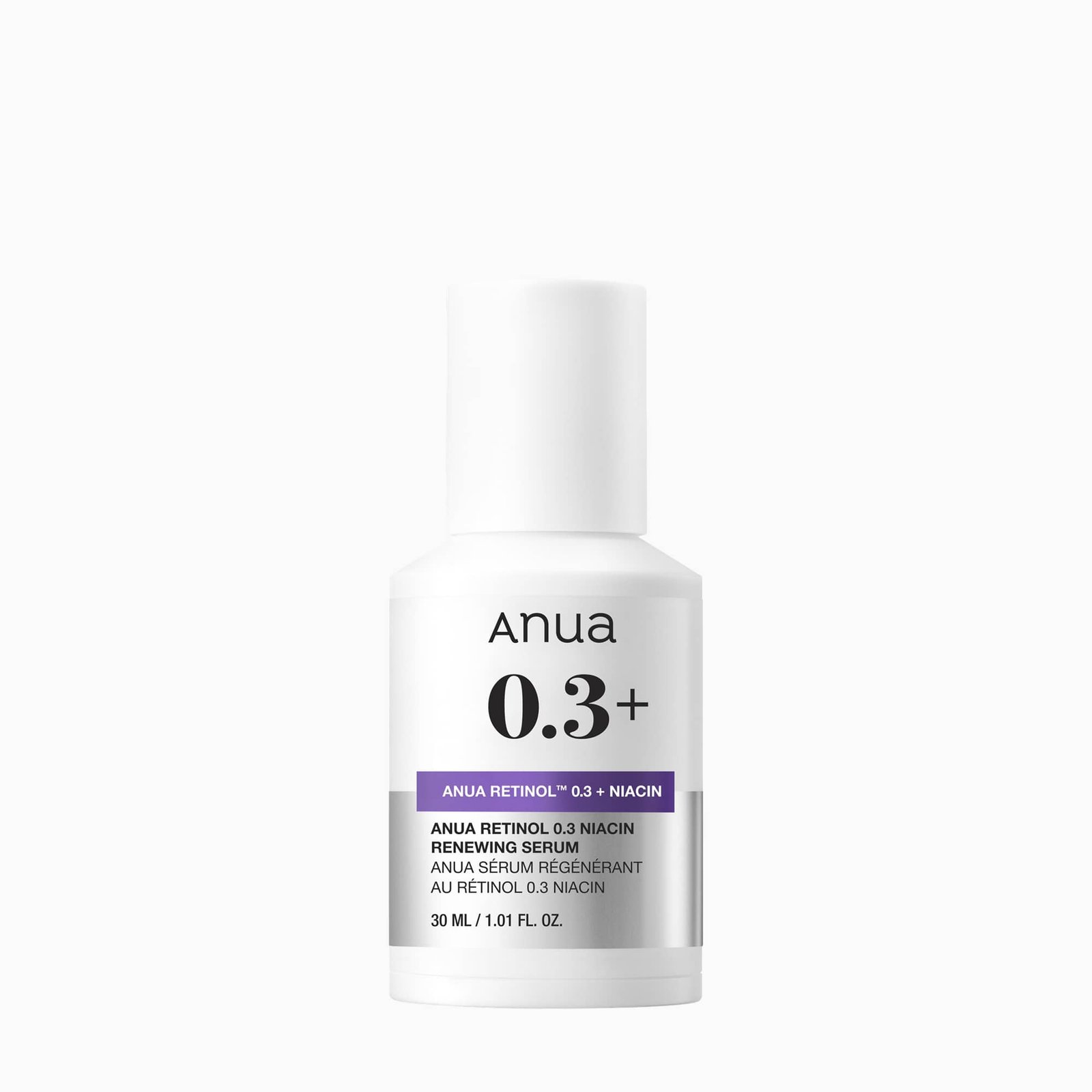
Anua Nano Retinol™ 0.3% + Niacin Renewing Serum — 30 ml
A starter-band 0.3% retinol with niacinamide built in as the buffer — from a line this library already trusts.
- 0.3% retinol: the top of the starter range, in a formula designed to be started slowly
- Niacinamide in the same bottle — the calming partner we recommend above
- Anua’s own guidance mirrors this guide: beginners start 2–3 times a week and increase gradually
$25 at Anua when we checked.
Check price at AnuaFrequently Asked Questions
How much retinol should I apply the first time?
A pea-sized amount for the entire face — that is the whole dose, first night and every night. If a pea feels like nothing, good: with retinoids, restraint is the mechanism.
How long until I see results?
Texture can shift in 4–6 weeks; a fair judgment takes 8–12 weeks of consistent use, and the deeper changes (fine lines, pigmentation) run on a 3–6 month clock. Anyone promising faster is selling the 11× conversion number as a results number.
Can I use retinol on my neck?
Carefully and diluted: fewer nights, sandwich always, stop at the jawline if your neck protests. Expect texture help, not lifting — no cream reverses sagging.
What if I miss nights or my skin gets irritated mid-way?
Consistency beats intensity over months. If irritation flares, pause until calm, then restart one rung lower on the schedule. Restarting gently is the protocol working, not failing. A stressed barrier needs repair first — Guide #22 is the reset routine.
Can I use retinol while pregnant or trying?
No. Avoid all retinoids — retinol, retinal, tretinoin, adapalene — during pregnancy, when trying to conceive, and while breastfeeding, and ask your doctor about alternatives such as azelaic acid or bakuchiol for your specific situation.
Retinol or retinal — which should a beginner buy?
Retinol first: cheaper, gentler per step, and the best documented. Retinal is the step-up once a full retinol ramp feels boring — same rules, lower percentages, higher price.
The Bottom Line
Retinol rewards exactly one personality trait: patience. Buy the low percentage, use the pea, climb the schedule only when the previous rung is calm, keep the strong friends off its nights, and let sunscreen hold the morning shift. Do that, and the ingredient with the deepest evidence in skincare will do what it has quietly done in studies for decades. Rush it, and you will join the internet’s largest focus group: people who quit in week two and blame the molecule.
Sources & Further Reading
- UNC Health Talk — Frequently Asked Questions About Retinoids (dermatologist Q&A: pea-sized dose, start slow, pregnancy warning).
- Dermatology Advisor — Retinoids factsheet (OTC vs prescription, adverse effects, 8–12 week improvements).
- Dhaliwal S. et al. (2019) — Prospective, randomized, double-blind assessment of topical bakuchiol and retinol for facial photoageing, British Journal of Dermatology.
- The INKEY List — Retinol vs Retinal (the conversion pathway and the origin of the “11× faster” framing).
- NeedSkincare — Retinol for beginners: how to start without peeling (starter strengths, sandwich method, pregnancy rule).
Affiliate disclosure: Glow & Vital is reader-supported. Some links in this guide — including the Anua link above — are affiliate links, and we may earn a commission if you buy through them, at no extra cost to you. That is how this library stays free. We recommend products by fit and evidence, never by commission rate, and we say so when a popular claim does not survive inspection — as with the “11× faster” audit in this guide.