
It is the most shareable object in skincare right now: a pink hydrogel sheet that goes on opaque and turns transparent over hours, or a clear film you paint on at night and peel off in one piece at dawn. And the research behind this guide kept circling one question, asked three different ways: do collagen masks actually work? The honest answer is yes — and not for the reason on the box. What these masks do genuinely well is one of the oldest tricks in dermatology, dressed in K-beauty’s best packaging. What they do not do is the thing their name promises. Both halves matter, because the first half is a real reason to use one before a big day, and the second half is how you avoid paying for a miracle and receiving a moisturizer. This is Guide #18 of The Radiant Routine: the two formats, the real mechanism, exactly how to use each, how often, the side effects nobody puts on the packaging, and who should skip the whole category.
Quick note: the products below carry affiliate links — our full disclosure is at the end of this article.
The Quick Answer
Overnight collagen masks work as occlusive hydration events: a sealed layer holds water and humectants against your skin for hours, so you wake up plumped, dewy and smoother-looking — temporarily. The effect is real and it is cosmetic, lasting hours rather than accumulating into new collagen. Use one like you’d book a facial: before an event, or on a pamper night once or twice a week, not as a nightly replacement for a routine. The two formats below — a hydrogel sheet and a peel-off wrapping film — achieve the same seal by different means; the choice between them is about texture, mess and your skin’s tolerance, which this guide walks through honestly.
What These Masks Actually Are
Strip the word “collagen” off the category and two product architectures remain. The first is the hydrogel sheet: a jelly-solid mask, usually in two pieces, saturated with a water-based essence of humectants (glycerin, hyaluronic acid), ferments and, yes, collagen extract. It wears for hours and visibly thins and clears as its water transfers and evaporates — the transformation is the marketing and the mechanism in one image. The second is the wrapping film: a gel you spread on yourself, built on a film-forming polymer, which dries in about fifteen minutes into a peelable skin that seals your evening routine in overnight. Same destination — an occlusive seal, worn long — by two different roads.
The Honest Mechanism: Water, Not Collagen Delivery
Here is the part the packaging can’t say. Collagen is a very large molecule. Applied to the surface of intact skin, collagen — including the hydrolyzed and “low-molecular” forms these brands advertise — works as a surface hydrator and film: it holds water at the surface and smooths the look of fine lines while it’s there. It does not travel down and take up residence as new dermal collagen; your skin builds that itself, slowly, from the inside, and the topical ingredients with real evidence for nudging that process are a different family entirely (the retinoids — more on that comparison below). So why does the morning mirror look so good? Because occlusion plus humectants plus time is a powerful cosmetic combination: hours of sealed-in hydration plump the outer layer, and plumped skin reflects light evenly, softens the look of lines and takes makeup beautifully. That glow is genuine — it’s just hydration wearing a collagen costume, and it fades over the following day or so. Judged as what it is — the best single-evening hydration event in the category — the format earns its fame. Judged as collagen replacement, nothing in a sachet could pass, and you should let any brand implying otherwise keep its mask.
The Hydrogel Sheet: Biodance Bio-Collagen Real Deep Mask
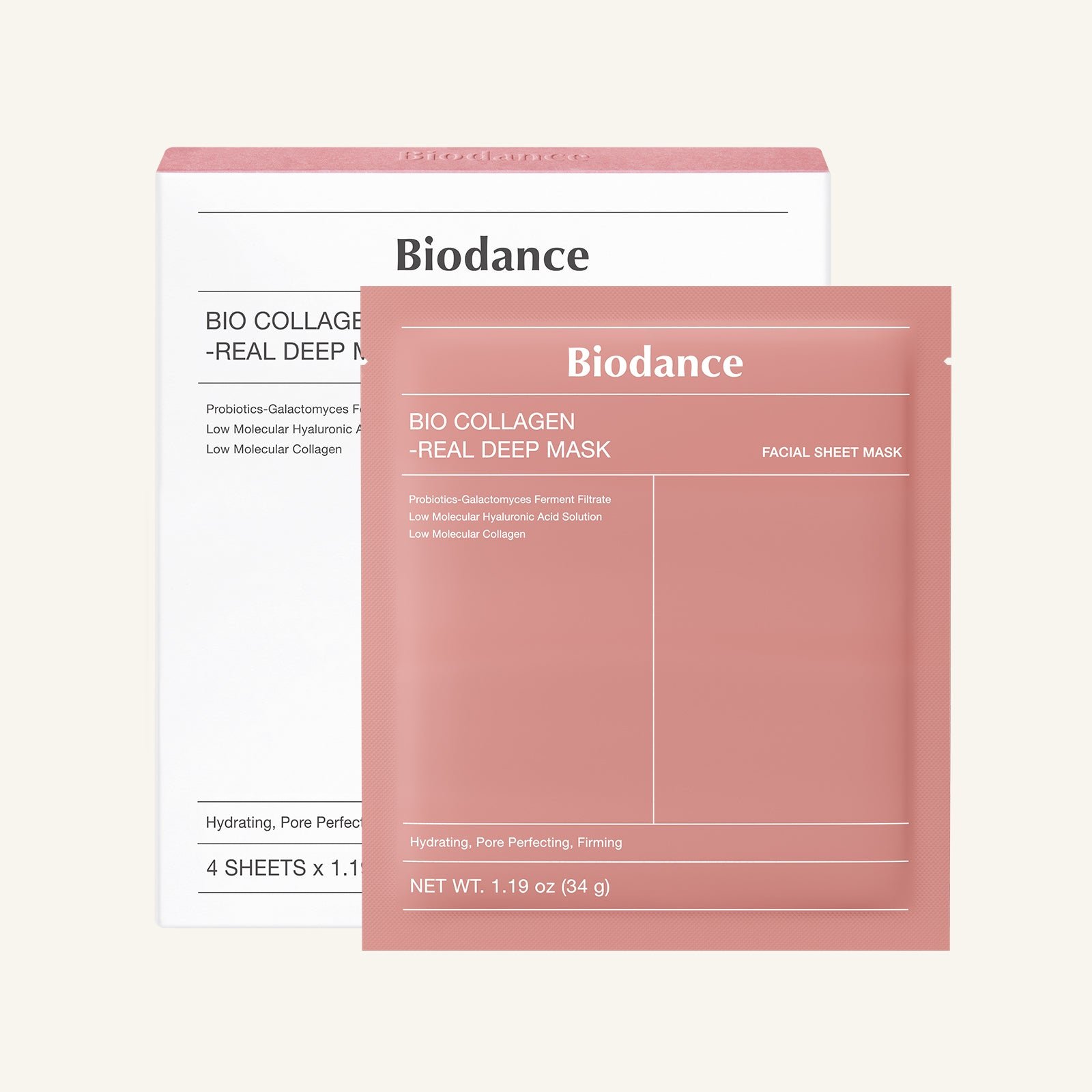
Biodance Bio-Collagen Real Deep Mask (4 count) — the viral original, already introduced in Guide #16 as the pamper-night gift. Two hydrogel pieces (forehead/eyes, then nose/mouth/chin) go on after cleansing and toner — serum too, if it’s part of your night — and stay on for three to four hours, or overnight, until the sheet turns transparent. The formula around the collagen extract is the working crew: galactomyces ferment, niacinamide, hydrolyzed hyaluronic acid, glycerin. Remove, pat in what’s left, and do not wash your face afterward — rinsing throws away the essence you just spent four hours delivering. The cut-out eye and mouth pieces aren’t waste, by the way: the brand suggests pressing them onto the sides of the nose, under-eyes or neck. Single use, and priced like an occasion, which is exactly how to treat it.
The Wrapping Film: medicube Collagen Night Wrapping Mask
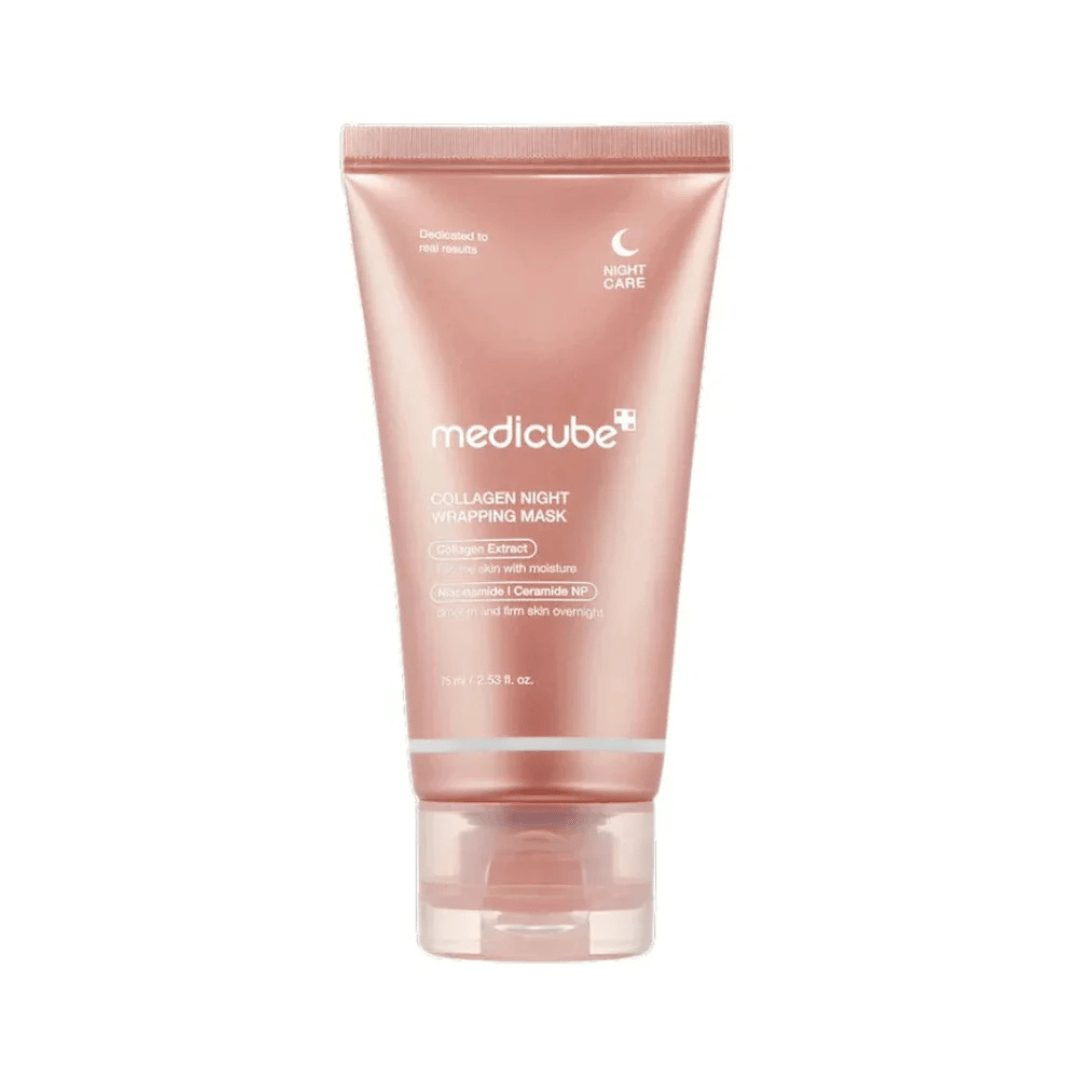
medicube Collagen Night Wrapping Mask (75 ml, with jelly brush) — the paint-on alternative. As the last step of your evening routine, spread an even layer with the brush, avoiding eyes, lips, eyebrows and hairline; give it about fifteen minutes to dry into its film, then sleep in it. In the morning, peel from the edges or rinse the residue away with lukewarm water. The ingredient list tells this guide’s favorite honest story: right after water comes polyvinyl alcohol — the film-former, the seal itself — followed by glycerin, niacinamide, sodium hyaluronate, adenosine and ceramide NP, with collagen extract appearing near the end of the list. Translation: this is a well-built occlusive night film with a solid supporting cast, named after its most marketable ingredient rather than its hardest-working one. Per tube rather than per sachet, it’s also the more economical of the two if the ritual becomes a habit — the brand suggests two to three nights a week, with sensitive skin starting at one or two.
How Often, and How to Get It Right
- Frequency: one to three nights a week is the honest range — the film’s brand guidance tops out at three, and the hydrogel is an occasion product by price and design. Nightly occlusion is not “more results”; it’s more chances to irritate skin that never gets a night off.
- Keep the layer underneath simple. Cleanse, a hydrating toner or a plain serum, then the mask. This is not the night for strong acids or a fresh retinoid underneath a sealed film — occlusion intensifies whatever it traps, in both directions.
- Timing is the product. A hydrogel worn for twenty minutes is an expensive sheet mask; the hours are what you’re paying for. If you can’t give it three hours or the night, save the sachet for an evening you can.
- Morning after: hydrogel — pat in, don’t rinse, moisturize if needed. Film — peel gently from the edges; if it resists, rinse it off with lukewarm water instead of pulling. Then the day routine as usual, SPF included.
Side Effects, and Who Should Skip Them
The category’s side-effect profile is mild but real, and it clusters exactly where the mechanism predicts. Breakout-prone and very oily skin is the first caution: hours of sealed warmth over active congestion can aggravate it — the same occlusion that plumps dry skin can trap what congested skin is trying to clear. Sensitive and reactive skin should patch-test and start with the hydrogel worn for the shorter window, and treat the peel-off film carefully: removal is a mild mechanical exfoliation whether it’s marketed as one or not, and tugging a film off already-irritated skin is a bad evening. Skip both formats entirely on broken, sunburned or mid-flare skin, and skip the category altogether if what you actually want is lifting or firming that lasts — disappointment is the worst side effect here, and it’s the one the marketing causes. Finally, a note for the over-60 readers this guide’s research showed asking: nothing about age disqualifies you — drier, thinner skin often enjoys the hydration most — but peel gently, patch-test first, and let the film come off with water rather than force.
Collagen Mask vs. Retinol: Different Jobs
The research asked this comparison repeatedly, so let’s settle it cleanly. A collagen mask is an event: surface hydration, tonight, gone by the weekend. A retinoid is a program: months of consistent use, with the strongest evidence base of any topical for supporting the skin’s own collagen over time. They don’t compete; they don’t substitute. And when an advertisement claims something “works 11 times faster than retinol,” it is comparing an evening’s hydration to a season’s remodeling and hoping you won’t notice the units changed. As for rebuilding collagen in the broader, honest sense: the levers are boring and real — daily sun protection (ultraviolet light is collagen’s best-documented enemy), not smoking, adequate protein and vitamin C as raw materials, sleep, and a retinoid if your skin tolerates one. No food “holds” collagen for your face, and no mask rebuilds what those habits protect.
FAQ
Do collagen overnight masks actually work?
Yes — as occlusive hydration. Hours under a sealed, humectant-rich layer plump the skin’s surface, soften the look of fine lines and produce the famous morning glow. What they don’t do is deliver collagen into the dermis or rebuild it; the benefit is real, cosmetic and temporary, and priced fairly only when you know that’s what you’re buying.
Am I supposed to wash my face after an overnight collagen mask?
It depends on the format. Hydrogel sheet: no — remove it and pat the remaining essence in; washing undoes the delivery. Wrapping film: the mask itself comes off in the morning, peeled from the edges or rinsed away with lukewarm water, and then you simply continue your morning routine.
How often should I wear one?
One to three nights a week. The wrapping film’s own guidance is two to three (sensitive skin: start at one or two), and the hydrogel is designed as an occasion — before events, on pamper nights. More frequent use buys irritation risk, not faster results.
What are the side effects of a collagen sleeping mask?
Mostly the predictable ones: breakouts on congestion-prone skin from hours of occlusion, irritation if worn over strong actives or on already-reactive skin, and tugging from peel-off removal. Patch-test, keep the under-layer gentle, and never apply either format to broken or sunburned skin.
Can I make a collagen mask at home?
You can make a mask at home; you can’t easily make this one. DIY gelatin and kitchen masks are single short sessions — the product here is engineered wear-time: a stable hydrogel or film that stays sealed and comfortable for hours. The homemade version is a pleasant ritual, not an equivalent, and no version, homemade or bought, puts collagen into your skin.
The Bottom Line
Buy the glow with your eyes open: an overnight collagen mask is the category’s best single-evening hydration event — hours of sealed water and humectants that leave skin plumped for the day that matters. The hydrogel is the occasion version, the wrapping film the economical ritual, and neither replaces a routine, a retinoid or a sunscreen. Used that way, it’s not a scam or a miracle; it’s a good tool with an honest job description, which is all this series ever asks. Next in Wave 4, Guide #19 takes the same honesty to winter hair: dryness, static and breakage, and what oil can and can’t do about them.
Sources & Further Reading
- Biodance Bio-Collagen Real Deep Mask — usage directions and full ingredient list (two-piece hydrogel; daytime 3–4 hours or overnight until transparent; galactomyces, niacinamide, hydrolyzed hyaluronic acid, collagen extract), via the product’s retail ingredient listing. https://kbeautyworld.com/products/biodance-bio-collagen-real-deep-mask-12
- medicube Collagen Night Wrapping Mask — how-to and full ingredient list (polyvinyl alcohol film-former; niacinamide, sodium hyaluronate, adenosine, ceramide NP; collagen extract late in the list; dry 15 minutes, peel or rinse in the morning). https://beautyontapp.com/products/collagen-night-wrapping-mask
- medicube Collagen Night Wrapping Mask — corroborating ingredient listing (triple collagen complex, panthenol and squalane notes; the same apply-dry-peel directions), via Moida K-Beauty. https://moida.co.uk/products/medicube-collagen-night-wrapping-mask-75ml
- Glow & Vital, this series — Guide #16 (the Biodance mask’s first appearance, as the pamper-night gift) and Guide #17 (the winter barrier routine these masks slot into as the occasional occlusive evening). https://glowandvital.com/all-guides/
Affiliate Disclosure
Glow & Vital is reader-supported. Some links in this article are affiliate links, which means we may earn a commission if you buy through them — at no additional cost to you. As an Amazon Associate, we earn from qualifying purchases. Affiliate relationships never determine which products we recommend; picks are based on ingredient research, formulation quality and fit for the guide’s purpose. This article is educational and is not medical advice.