
Our beginner’s guide to vitamins (Guide #11) made one honest admission: the most talked-about “vitamin” in the pharmacy isn’t a vitamin at all. Omega-3s are essential fats — and they generate more confident nonsense per capsule than almost anything else on the shelf. One name hides three different molecules, the big number on the front of the bottle is almost never the number that matters, and the headlines swing between “miracle for your heart” and “cardiologists say stop” depending on the week. This guide sorts out what omega-3s actually are, what the evidence supports, and how to read a fish oil label like someone who can’t be fooled.
Quick note: the product picks in this guide include affiliate links — our full disclosure is at the end of this article.
A note before we start: this guide is educational, not medical advice. Supplements can interact with prescription medicines and health conditions, so if you take medication — especially a blood thinner — or are pregnant or nursing, check with your doctor or pharmacist before adding anything new.
The Quick Answer
There are three main omega-3s: ALA (from plants), and EPA and DHA (from fish and seafood). Your body converts ALA into EPA and DHA so poorly — under 15% — that eating EPA and DHA directly is the only practical way to raise them. The strongest, most consistent findings are these: eating fatty fish once or twice a week supports heart health, and EPA/DHA reliably lower triglycerides. Beyond that, the evidence gets specific and modest: the American Heart Association does not recommend omega-3 supplements for people who don’t have a high cardiovascular risk. If you do buy fish oil, ignore the front of the bottle and compare the EPA + DHA per serving on the back — that number, not “fish oil mg,” is what you’re paying for.
Three Molecules, One Name: ALA, EPA and DHA
“Omega-3” is a family name, and the family members do different jobs:
- ALA (alpha-linolenic acid) — the plant omega-3, found in flaxseed, soybean and canola oils, chia seeds and walnuts. ALA is genuinely essential: your body can’t make it, so it must come from food. Adults need about 1.6 g a day (men) or 1.1 g (women) — and most Americans get enough from ordinary cooking oils and foods.
- EPA (eicosapentaenoic acid) — the long-chain omega-3 most involved in signaling: EPA is a raw material for eicosanoids, messenger molecules that help regulate inflammation, blood vessels and clotting.
- DHA (docosahexaenoic acid) — the structural one. DHA is a building block of cell membranes and is concentrated where membranes do precision work: it’s especially high in the retina, the brain and sperm.
EPA and DHA come from fish and seafood — though the fish didn’t make them. Microalgae at the base of the marine food chain produce EPA and DHA; fish accumulate them as they eat. That’s also why algal oil exists as a vegetarian supplement source.
The catch with ALA: your liver can convert it into EPA and then DHA, but the conversion rate is under 15% — and that’s the generous end of the estimates. Eating a tablespoon of flaxseed oil is a fine thing to do; it is not a substitute for the EPA and DHA in a serving of salmon. This single fact explains most of the confusion in the category: “omega-3” on a plant product and “omega-3” on a fish oil are barely the same conversation.
What Omega-3s Actually Do in Your Body
Strip away the marketing and two jobs remain, both well documented:
Structure. Omega-3s are built into the phospholipids that form every cell membrane in your body. DHA’s concentration in the retina and brain is why it gets so much attention in pregnancy and infant development: during pregnancy, eating 8 to 12 ounces a week of low-mercury fish (salmon, sardines, herring, trout) may improve a baby’s health — one of the few supplement-adjacent recommendations health agencies make confidently.
Signaling. Along with omega-6 fats, omega-3s are converted into eicosanoids — short-lived messengers with wide-ranging roles in the cardiovascular, pulmonary, immune and endocrine systems. In broad terms, eicosanoids made from EPA and DHA tend toward less inflammatory activity than those made from omega-6 arachidonic acid, which is the mechanistic story behind most omega-3 research. A mechanism, note, is not a promise: it explains why scientists study omega-3s for so many conditions, and also why so many of those studies end with “promising, more research needed.”
The Heart Question, Answered Honestly
Heart health is why most people buy fish oil, so here is the evidence in the order a skeptical reader would want it:
- Fish itself: consistently good. People who eat fatty fish and seafood as part of a healthy eating pattern have healthier hearts, especially when the seafood replaces less healthy foods. The AHA recommends one to two servings of seafood per week.
- Triglycerides: the real effect. Getting more EPA and DHA — from food or supplements — lowers triglyceride levels. Across trials, the Cochrane review found reductions of about 15%. At prescription doses (4 g a day of prescription omega-3 medicines), the triglyceride effect is a recognized treatment tool. That’s prescription medicine territory, not a reason to megadose store capsules.
- Preventing heart disease in healthy people: weak. Large trials of ordinary fish oil supplements in people without heart disease have been disappointing. The AHA’s position is explicit: it does not recommend omega-3 supplements for people who do not have a high cardiovascular risk.
- People who already have heart disease: a different answer. For someone with existing coronary heart disease, the AHA suggests about 1 g a day of EPA plus DHA — preferably from oily fish — with supplements an option under a doctor’s guidance. The evidence for benefit is stronger here than in healthy people.
- The FDA’s own wording tells the story. The authorized claim for EPA and DHA is a qualified one: “Supportive but not conclusive research shows that consumption of EPA and DHA omega-3 fatty acids may reduce the risk of coronary heart disease.” When the regulator’s approved sentence contains “but not conclusive,” believe it.
And a useful honesty check from another aisle: dry eye. Fish oil was marketed for years as the natural answer, until a large trial gave people 2,000 mg of EPA plus 1,000 mg of DHA daily for a full year — and their symptoms improved no more than the placebo group’s. Omega-3s are real nutrients with real jobs. They are not a general-purpose remedy, and any bottle that presents them as one is telling you something about the bottle, not the nutrient.
“Why Do Cardiologists Say Stop Fish Oil?”
This is one of the most-searched omega-3 questions, and it deserves a straight answer instead of a scare headline. The “stop” headlines come from three real things, none of which mean fish oil is poison:
- The AHA doesn’t recommend supplements for low-risk people — because trials didn’t show prevention benefits there. “No reason to start” got compressed by headlines into “stop.”
- Prescription-dose trials found an atrial fibrillation signal. In two large trials, people with cardiovascular disease or high risk who took 4 g a day — four times a typical supplement dose, as a prescription drug, for years — had a slightly higher risk of atrial fibrillation. That’s a real finding about high doses in high-risk patients under medical care; it’s routinely misreported as if it were about a daily 1 g capsule.
- Some much-hyped trials simply failed. When a big, well-run trial of a popular supplement shows no benefit, the coverage reads like a reversal. It isn’t one: it’s the original claims that were ahead of the evidence.
What cardiologists actually say, in guidelines rather than headlines: eat fish, don’t expect a capsule to substitute for it, and if you have heart disease or high triglycerides, the omega-3 conversation belongs with your care team — because at that point you’re discussing treatment, not wellness shopping.
Is It Safe to Take Every Day?
For most healthy adults at ordinary doses, omega-3 supplements have a benign safety profile — which is not the same as “no considerations”:
- There’s no official upper limit, but there is a practical ceiling. No UL has been set for omega-3s. The FDA recommends consuming no more than 5 g a day of EPA and DHA combined from supplements — several times what a typical one- or two-capsule routine provides.
- Side effects are usually mild and mostly gastrointestinal: an unpleasant taste, fishy burps, bad breath, heartburn, nausea, stomach discomfort, diarrhea, headache, and — the odd one nobody warns you about — smelly sweat. Taking capsules with a meal helps with most of these.
- Blood thinners are the serious flag. High doses of omega-3s may cause bleeding problems when taken with warfarin (Coumadin) or other anticoagulant medicines. If you take a blood thinner, this is a conversation with your doctor or pharmacist before the bottle, not after.
- Ask first if: you take anticoagulant or antiplatelet medication, you’re scheduled for surgery, you’re pregnant or nursing, or you have a fish or shellfish allergy. (And note that fish oil supplements themselves have not been found to contain methylmercury — it’s removed during processing and purification.)
- Cod liver oil is a different product. It provides vitamins A and D on top of omega-3s — and vitamin A has a firm upper limit (see Guide #11). Don’t stack cod liver oil with a multivitamin and a vitamin D capsule without adding up the A and D.
Food First: The Numbers That End Arguments
Two of the most common omega-3 questions collapse the moment you put servings side by side:
- A 3-ounce serving of farmed Atlantic salmon: about 1.24 g of DHA plus 0.59 g of EPA — roughly 1.8 g of long-chain omega-3s, with protein, vitamin D and selenium included free of charge.
- Sardines, 3 ounces: about 0.74 g DHA plus 0.45 g EPA — over a gram, at a fraction of salmon’s price. Herring is in the same league.
- Two eggs: a regular cooked egg contains about 0.03 g of DHA and essentially no EPA. Two eggs give you ~0.06 g — about 3% of the salmon serving. Eggs are nutritious; they are not an omega-3 source (unless you buy the specially fortified kind, which says so on the carton).
- Fruit? None. No fruit is meaningfully high in omega-3s. The ALA champions are seeds, nuts and their oils: flaxseed oil (7.26 g of ALA in a tablespoon), chia seeds (5.06 g per ounce), walnuts (2.57 g per ounce). Remember, though, that ALA converts to EPA and DHA at under 15% — plant omega-3s complement fish; they don’t replace it.
That’s the food-first math: two oily-fish meals a week put most people ahead of what a standard capsule habit delivers — and the capsule makes the most sense precisely for people who won’t or can’t eat the fish.
How to Choose a Fish Oil: Read the Back Label
If you’ve decided a supplement fits your situation, five checks separate an honest bottle from an expensive one:
- 1. Compare EPA + DHA per serving — never “fish oil mg.” A typical fish oil capsule advertises 1,000 mg of fish oil on the front; the Supplement Facts on the back reveal about 180 mg of EPA and 120 mg of DHA — 300 mg of actual omega-3s, a 30% concentration. That’s the industry’s standard trick, and the back label is the only place it’s undone.
- 2. Do the servings math. Check how many capsules make a “serving,” and how many servings the bottle really contains. A 60-capsule bottle at two per serving is a one-month supply wearing a two-month costume.
- 3. Look at the form. Fish oil comes as natural triglycerides, ethyl esters (a cheaper, concentrated form), re-esterified triglycerides, or phospholipids (krill oil). The triglyceride forms have somewhat higher bioavailability than ethyl esters — but every form significantly raises EPA and DHA levels, so form matters less than dose honesty.
- 4. Require third-party testing. Look for an independent quality program — IFOS, USP or NSF certification, or a published certificate of analysis. You’re checking two things: that the EPA/DHA match the label, and that oxidation and contaminants were measured, not assumed.
- 5. Respect freshness. Fish oil oxidizes. Buy from sellers with real turnover, check the date, store it cool and dark, and trust your nose: a bottle that smells aggressively fishy before you’ve swallowed anything is telling you it’s past its best — return it.
Here is that checklist applied to the bottle this series uses as its worked example — the same one introduced in Guide #11:
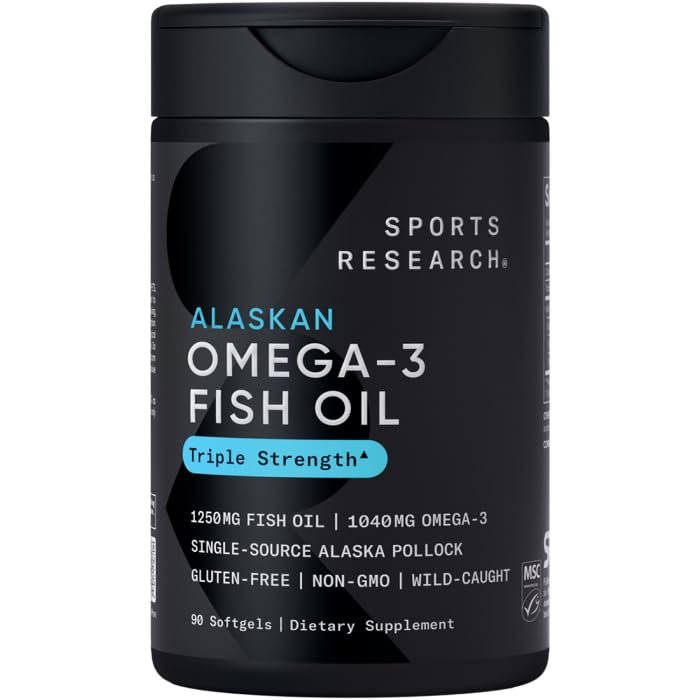
Sports Research Omega-3 Fish Oil (1250 mg, 90 softgels) — run it through the five checks: the back label states 1,040 mg of omega-3s per single-softgel serving — against 1,250 mg of fish oil, that’s roughly an 83% concentration, versus ~30% in a typical capsule; the serving is one softgel, so 90 softgels really are 90 servings; the oil comes from single-source Alaska pollock; and the EPA/DHA split is printed in the Supplement Facts rather than hidden behind a blend. It’s the rare front label that survives its own back label — which is exactly the standard to hold any bottle to, ours included.
FAQ
Is it okay to take omega-3 fish oil every day?
Yes — daily use at typical doses (around 1 g of EPA + DHA) is the pattern studied and is considered safe for most healthy adults; the FDA’s recommended ceiling from supplements is 5 g a day of EPA and DHA combined. The cautions are specific, not general: blood thinners, surgery, pregnancy, and prescription-level doses all change the conversation.
What are the signs you need omega-3?
Honestly, there isn’t a reliable symptom checklist. True omega-3 deficiency is very rare in the United States, and its documented signs — rough, scaly skin and a red, swollen, itchy rash — match a dozen more common conditions. The useful question isn’t “do I feel deficient?” but “do I ever eat oily fish?” If the answer is never, your EPA and DHA intake is low by arithmetic, not by symptoms.
Are 2 eggs enough omega-3?
No. A regular egg carries about 0.03 g of DHA and virtually no EPA, so two eggs deliver roughly 3% of the long-chain omega-3s in a 3-ounce serving of salmon. Omega-3-fortified eggs (from hens fed flax or algae) are the exception — and they say so on the carton.
What fruit is very high in omega-3?
None, unfortunately — fruit is simply not where omega-3s live. The richest plant sources are seeds, nuts and oils: flaxseed oil, chia seeds, walnuts. And remember the conversion caveat: plant ALA becomes EPA and DHA at under 15%.
Who should not take omega-3 fish oil?
Nobody is categorically banned, but three groups should talk to a clinician first: people taking warfarin or other anticoagulants (high doses can add bleeding risk), people scheduled for surgery, and people with a fish or shellfish allergy. Anyone with heart disease considering higher doses should also be having that conversation with their cardiology team — the atrial fibrillation signal appeared at 4 g a day in exactly that population.
What is the best time of day to take fish oil?
Whenever you’ll remember it — with a meal. Taking it with food (ideally a meal containing some fat) aids absorption and noticeably reduces the fishy-burp side effect. Morning or evening makes no difference; consistency does.
The Bottom Line
Omega-3s reward the same approach as everything else in this series: name the molecule, check the dose, read the back label. ALA is essential and easy to get; EPA and DHA are the long-chain pair with the real evidence, and food — two oily-fish meals a week — remains the best-supported way to get them. Supplements have a legitimate, narrower job: covering people who don’t eat fish, and, at prescription doses under medical care, treating high triglycerides. Buy them with your eyes open, compare EPA + DHA per serving, and let any headline that says “miracle” or “stop everything” send you back to the guidelines — they’re calmer, and they’re right. Next in the series, Guide #13 examines CoQ10 — what it is, who takes it, and what separates ubiquinone from ubiquinol.
Sources & Further Reading
- NIH Office of Dietary Supplements — Omega-3 Fatty Acids Fact Sheet for Consumers: the three omega-3s, ALA amounts, food sources, the FDA’s 5 g/day guidance, and medication interactions. https://ods.od.nih.gov/factsheets/Omega3FattyAcids-Consumer/
- NIH Office of Dietary Supplements — Omega-3 Fatty Acids Fact Sheet for Health Professionals: conversion rates, EPA/DHA food tables, the AHA advisories, trial evidence (including the atrial fibrillation findings), and safety data. https://ods.od.nih.gov/factsheets/Omega3FattyAcids-HealthProfessional/
- American Heart Association — Omega-3 Fatty Acids: why the AHA recommends one to two seafood servings a week, and who supplements are and aren’t recommended for. https://www.heart.org/en/healthy-living/healthy-eating/eat-smart/fats/omega-3-fatty-acids
- Mayo Clinic — Omega-3 supplements: Are they right for you? A plain-language expert Q&A on benefits, risks and who should be cautious. https://www.mayoclinic.org/healthy-lifestyle/nutrition-and-healthy-eating/expert-answers/omega-3-supplements/faq-20064736
Affiliate Disclosure
Glow & Vital is reader-supported. Some links in this article are affiliate links, which means we may earn a commission if you buy through them — at no additional cost to you. As an Amazon Associate, we earn from qualifying purchases. Affiliate relationships never determine which products we recommend; picks are based on ingredient research, formulation quality and fit for the guide’s purpose. This article is educational and is not medical advice.