
Guide #11 introduced it in one sentence: CoQ10 is not a vitamin — it’s a compound your own cells manufacture. That sentence raises the obvious question this guide exists to answer: if your body makes it, why does anyone buy it? The honest answer sits between two exaggerations. CoQ10 is neither the heart miracle of the advertisements nor a scam — it’s a genuinely essential molecule with a genuinely inconclusive supplement literature, sold in two forms (ubiquinone and ubiquinol) whose price difference deserves scrutiny. Here is what it is, what the research actually shows, who takes it and why, and how to tell the two forms apart without a biochemistry degree.
Quick note: the product picks in this guide include affiliate links — our full disclosure is at the end of this article.
A note before we start: this guide is educational, not medical advice. CoQ10 can interact with prescription medicines — including warfarin and insulin — so if you take medication, are pregnant or nursing, or are being treated for a heart condition, check with your doctor or pharmacist before adding it.
The Quick Answer
CoQ10 (coenzyme Q10) is a fat-soluble compound your body produces and stores, most concentrated in your heart, liver, kidneys and pancreas. Inside your cells it does two jobs: it helps mitochondria turn food into energy (ATP), and it works as an antioxidant. Your levels decline with age, and statin drugs lower them further in the blood — which is why most CoQ10 buyers are over 50 or take a statin. The research verdict, though, is humbler than the marketing: the US National Center for Complementary and Integrative Health (NCCIH) calls the heart-failure evidence inconclusive and says the overall evidence does not support CoQ10 for statin muscle pain. It appears very safe — no serious side effects have been reported — so for most buyers the real question isn’t danger. It’s whether an unproven benefit is worth a monthly subscription.
What CoQ10 Actually Is
Every cell in your body contains mitochondria, and every mitochondrion runs an assembly line called the electron transport chain to produce ATP, your energy currency. CoQ10 is one of the carriers on that line, shuttling electrons between stations. Its second job is defensive: in its reduced form it’s an antioxidant, protecting cell membranes and the cholesterol-carrying particles in your blood from oxidative damage.
Three facts frame everything else:
- You make it yourself. Unlike a vitamin, CoQ10 isn’t essential from the diet — a healthy body synthesizes it. Production peaks in young adulthood and declines with age, which is why interest in it rises after 50.
- Food provides very little. The richest sources are meat, oily fish and organ meats, with smaller amounts in peanuts, soybean and canola oils and whole grains — but a typical diet delivers only about 3 to 6 mg a day. Supplement doses in studies run 100 to 300 mg. Food can’t close that gap, which makes CoQ10 unusual: this really is a supplement-first nutrient.
- Statins lower it. Statin drugs block the same production pathway (the mevalonate pathway) that your body uses to make both cholesterol and CoQ10. A meta-analysis of placebo-controlled trials found statin therapy lowers blood CoQ10 levels measurably. Whether that drop causes symptoms is the contested part — and it’s where the marketing runs ahead of the science.
What the Evidence Actually Shows
CoQ10 is marketed mainly for two things — the failing heart and the aching statin user — plus a supporting cast of claims. Judged separately, as they should be:
- Heart failure: genuinely unresolved. One well-known trial (Q-SYMBIO, 420 patients taking 300 mg a day) found striking benefits; a 2021 Cochrane review rated the evidence moderate-quality yet concluded there is no convincing evidence to support or refute CoQ10 in heart failure. The NCCIH’s summary is the fair one: research on CoQ10 in heart failure is inconclusive. Anyone with heart failure is also, by definition, under a cardiologist’s care — which is where this decision belongs.
- Statin muscle pain: the popular use with the weakest support. The logic is seductive — statins lower CoQ10, muscles ache, replace the CoQ10. But pooled analyses of the small trials disagree with each other, and the NCCIH’s reading of the whole body of work is blunt: the overall scientific evidence does not support the idea that CoQ10 reduces muscle pain caused by statins. Some individuals swear by it; the averages don’t.
- Blood pressure: probably very little. The NCCIH concludes the available evidence suggests CoQ10 probably doesn’t have a meaningful effect on blood pressure. It is not a blood-pressure treatment.
- Migraine: a modest maybe. A 2021 systematic review found CoQ10 may reduce the duration and frequency of migraines, though not their severity — with small studies and small effects, so the uncertainty is real.
- Cholesterol: no. CoQ10 does not lower cholesterol. That’s the statin’s job, and no supplement in this guide substitutes for it.
- Parkinson’s disease: tested, and no. A large NIH-funded trial, using higher-than-usual doses, found no improvement in early Parkinson’s symptoms.
- Heart surgery recovery: a quiet positive. The NCCIH notes evidence that CoQ10 may reduce the risk of some complications of heart surgery — one of the few places the data leans favorable, and again a decision for the surgical team, not the supplement aisle.
“Why Don’t Doctors Recommend CoQ10?”
It’s one of the most-asked questions in this category, and the answer is more bureaucratic than sinister. Doctors work from guidelines, and guidelines require consistent evidence. CoQ10 has: no approved medical use, no standardized dose, a flagship trial contradicted by a Cochrane shrug, and a most-popular use (statin pain) that the overall evidence doesn’t support. Cardiology guidelines simply don’t include it — so most doctors don’t recommend it, and many will tell a patient who wants to try it that it’s unlikely to harm and unproven to help. That’s not a conspiracy against a natural molecule; it’s what “inconclusive” looks like when a professional has to sign their name to advice. If your doctor shrugs about CoQ10, you’ve heard the evidence accurately.
The Statin Question, Carefully
Because the tree of real search questions keeps returning here — “what happens if you don’t take CoQ10 with statins?” — let’s be exact. Nothing obliges a statin user to take CoQ10; it is not part of any standard statin protocol. Statins do lower blood CoQ10 levels, and the depletion theory of muscle symptoms is biologically plausible — but plausibility plus mixed small trials equals “unproven,” which is where the science currently stops.
Two safety rails matter more than the supplement itself:
- Never stop or reduce a statin on your own because of muscle aches. Stopping a statin raises cardiovascular risk — that harm is proven, unlike the supplement’s benefit. Muscle symptoms on a statin are a conversation with the prescriber, who has real options: a different statin, a different dose, a schedule change.
- If you and your doctor decide to trial CoQ10 anyway — a common, reasonable experiment given its safety profile — treat it as an experiment: one change at a time, a defined window (the trials typically ran 4 to 12 weeks), and an honest before-and-after on your symptoms. Vibes are not data, even your own.
Ubiquinone vs. Ubiquinol: The Two Forms, Decoded
CoQ10 exists in your body in two states, endlessly converting back and forth: ubiquinone, the oxidized form, and ubiquinol, the reduced form — the one that does the antioxidant work. Supplements sell both, ubiquinol at a noticeable premium. What’s actually different?
- Your body converts freely. Whichever form you swallow, it’s converted as needed, and most of the CoQ10 circulating in your blood is ubiquinol either way. The form on the label is a starting point, not a destination.
- Absorption may differ, especially with age. Some small studies find ubiquinol supplements raise blood levels more than the same dose of ubiquinone, with the gap widest in older adults — the very group whose conversion capacity and production are declining. The evidence is suggestive, not definitive.
- The trial record belongs to ubiquinone. Nearly all the classic research — including the heart-failure and statin trials above — used ubiquinone, typically in oil-based softgels. It’s also cheaper and more shelf-stable; ubiquinol oxidizes easily and costs more to manufacture and package.
- Both are fat-soluble, and that matters more than the form. CoQ10 absorbs poorly without fat. A ubiquinone softgel taken with a real meal will outperform a ubiquinol capsule swallowed dry on an empty stomach. Dose and the meal beat the label’s form claim.
The practical verdict: if you’re younger, healthy, and price-sensitive, ubiquinone with food is a defensible, evidence-based default. If you’re over 50, take a statin, and the price difference doesn’t sting, ubiquinol is a reasonable upgrade on absorption grounds. What neither form licenses is an expectation of dramatic results — the molecule’s evidence problem is not solved by its oxidation state.
Who Should Ask First
CoQ10’s safety record is genuinely good — no serious side effects have been reported in the research — but “safe” has specific exceptions:
- Warfarin (Coumadin) users: the important one. CoQ10 is structurally similar to vitamin K and may make warfarin less effective, increasing clot risk — the opposite direction from fish oil’s caution. If you take warfarin, CoQ10 is a doctor conversation, full stop.
- Insulin and diabetes medications. The NCCIH flags a possible interaction with insulin; anyone managing blood sugar medically should loop in their care team.
- Cancer treatment. CoQ10 may not be compatible with some types of cancer therapy — antioxidant supplements during treatment are an oncologist’s call, never a self-prescription.
- Pregnancy and breastfeeding. Safety data are insufficient. The default for unstudied supplements in pregnancy is don’t, unless your obstetrician says otherwise.
- Anyone who finds it stimulating. Insomnia is among the mild side effects reported — which is why the standard practical advice is to take CoQ10 in the morning.
Taking It Every Day: Safety, Timing and the Extras
At the doses used in research (typically 100 to 300 mg a day), CoQ10 is well tolerated over months and years of trials. The reported side effects are mild: digestive upset and nausea lead the list, with headache and insomnia behind them. There’s no evidence it causes weight gain, and no signal of harm to liver or kidneys at studied doses. Three usage rules cover almost everyone:
- Take it with a meal containing fat — breakfast or lunch, ideally. Absorption depends on it.
- Morning beats night for most people, because of the insomnia reports — there’s no pharmacological prize for evening dosing.
- It stacks fine with most vitamins (it’s routinely sold alongside them), but “with other vitamins” is not the question that matters — “with my prescriptions” is, and that one goes to your pharmacist.
And a word on the skin claims, since they’re half the internet’s CoQ10 content: as an antioxidant, CoQ10 is plausibly relevant to skin, and it’s a common ingredient in creams. But oral CoQ10 for skin outcomes is, charitably, preliminary — nowhere near the studied uses above. Buy it, if you buy it, for the reasons in this guide.
CoQ10 vs. Fish Oil: The Question Everyone Asks
Search data says people constantly pit these two against each other — “which is better for the heart?” — but they’re not rivals; they’re different categories of thing. Omega-3s are essential fats you cannot make, with their strongest evidence in triglycerides and fish-based diets (Guide #12). CoQ10 is a compound you do make, concentrated in energy-hungry organs, with inconclusive evidence in heart failure and unsupported evidence for statin pain. If the goal is general heart-conscious nutrition, the fish oil conversation has the firmer ground. If the question is specifically “I take a statin and I’m curious,” that’s this guide — with its honest caveats. Plenty of people take both; nothing about either requires choosing a team.
The bottle this series uses as its worked example — introduced in Guide #11 — is a ubiquinone formula, chosen deliberately: it’s the form the research actually used.
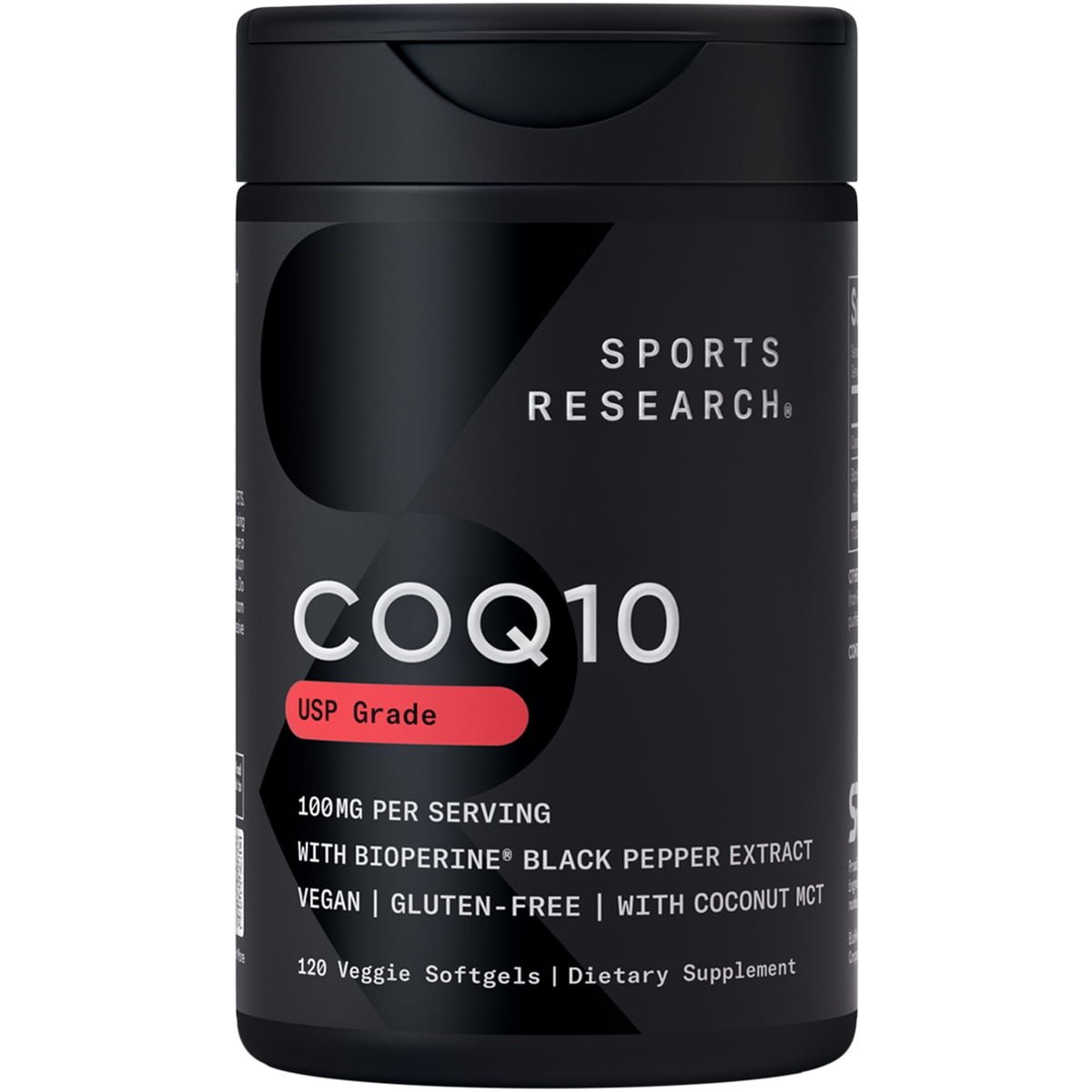
Sports Research CoQ10 (100 mg, 120 veggie softgels) — run it through this guide’s checks: the form is ubiquinone, the one used in the heart-failure and statin trials; the dose is 100 mg per softgel, the low end of the studied range, in a 120-count bottle (a four-month supply at one a day); and the formula is built for the fat-solubility problem, suspended with coconut MCT oil and BioPerine black pepper extract to support absorption. What it isn’t: a promise. It’s a clean, honestly labeled version of an unproven-but-safe supplement — which is exactly how we’d describe the category itself.
FAQ
Should I take CoQ10 in the morning or at night?
Morning, with breakfast. Two reasons: it’s fat-soluble, so it needs a meal with some fat to absorb well, and insomnia is one of its reported mild side effects — evening dosing occasionally leaves people wired. There’s no benefit to taking it at night.
What are the symptoms of low CoQ10?
There’s no reliable symptom checklist for the general population. True inherited CoQ10 deficiency is a rare genetic condition diagnosed in childhood, not something adults develop silently. Fatigue and muscle aches — the symptoms the internet attributes to “low CoQ10” — have dozens of more common causes. If you have them, that’s a workup for your doctor, not a diagnosis a supplement label can make.
Does CoQ10 lower cholesterol?
No. CoQ10 has no meaningful cholesterol-lowering effect, and it isn’t a substitute for a statin or any other lipid treatment. The two are connected only because statins lower CoQ10 levels while they lower cholesterol.
Can you take CoQ10 with other vitamins?
Generally yes — it’s commonly combined with multivitamins, vitamin E and omega-3s, and there are no famous vitamin conflicts. The interactions that matter involve prescription drugs: warfarin, insulin, and some cancer treatments. Prescriptions, not vitamins, are the checklist.
Is CoQ10 really worth taking?
Depends entirely on your expectation. As a guaranteed benefit: the evidence doesn’t support that for any use, and we won’t pretend otherwise. As a low-risk experiment — you’re over 50, you take a statin, the monthly cost is trivial to you, and you’ll judge it honestly over 8 to 12 weeks — it’s one of the more defensible gambles in the supplement aisle. The people it’s not worth it for are those expecting it to treat a heart condition or replace a prescribed drug.
What does CoQ10 do for skin?
Less than the ads suggest. CoQ10 is an antioxidant and a common ingredient in topical products, but evidence that taking it orally improves skin is thin and preliminary. If skin is your goal, the site’s skin-care guides (The Radiant Routine #1–3) start from ingredients with far better documentation.
The Bottom Line
CoQ10 is a real, essential molecule wrapped in an inconclusive supplement literature. Your body makes it; age and statins reduce it; the trials haven’t proven that replacing it fixes the problems it’s sold for — and it appears genuinely safe for most people who try. So buy it, if you buy it, the way this series buys everything: with the form understood (ubiquinone is the studied default; ubiquinol is the pricier, possibly better-absorbed option), the dose on the label, a fatty breakfast beside it, your prescriptions checked, and your expectations set to “unproven.” Next in the series, Guide #14 takes the same honest standard to the supplement aisle’s most expensive promise: hair growth supplements, and what Nutrafol can and can’t do.
Sources & Further Reading
- National Center for Complementary and Integrative Health (NCCIH) — Coenzyme Q10: the official US evidence summary — heart failure inconclusive, statin muscle pain unsupported, blood pressure probably unaffected, plus the safety and interaction profile. https://www.nccih.nih.gov/health/coenzyme-q10
- Mayo Clinic — Coenzyme Q10: evidence by condition, and the warfarin interaction explained (CoQ10 may make warfarin less effective). https://www.mayoclinic.org/drugs-supplements-coenzyme-q10/art-20362602
- Coenzyme Q10 (peer-reviewed clinical review, PMC): mechanisms, the statin–CoQ10 pathway, and the doses used across cardiac and neurological trials. https://pmc.ncbi.nlm.nih.gov/articles/PMC6822644/
- NCCIH — Complementary Health Approaches for Chronic Pain: What the Science Says: the 2021 review of CoQ10 for migraine (may reduce duration and frequency, not severity). https://www.nccih.nih.gov/health/providers/digest/complementary-health-approaches-for-chronic-pain-science
Affiliate Disclosure
Glow & Vital is reader-supported. Some links in this article are affiliate links, which means we may earn a commission if you buy through them — at no additional cost to you. As an Amazon Associate, we earn from qualifying purchases. Affiliate relationships never determine which products we recommend; picks are based on ingredient research, formulation quality and fit for the guide’s purpose. This article is educational and is not medical advice.